

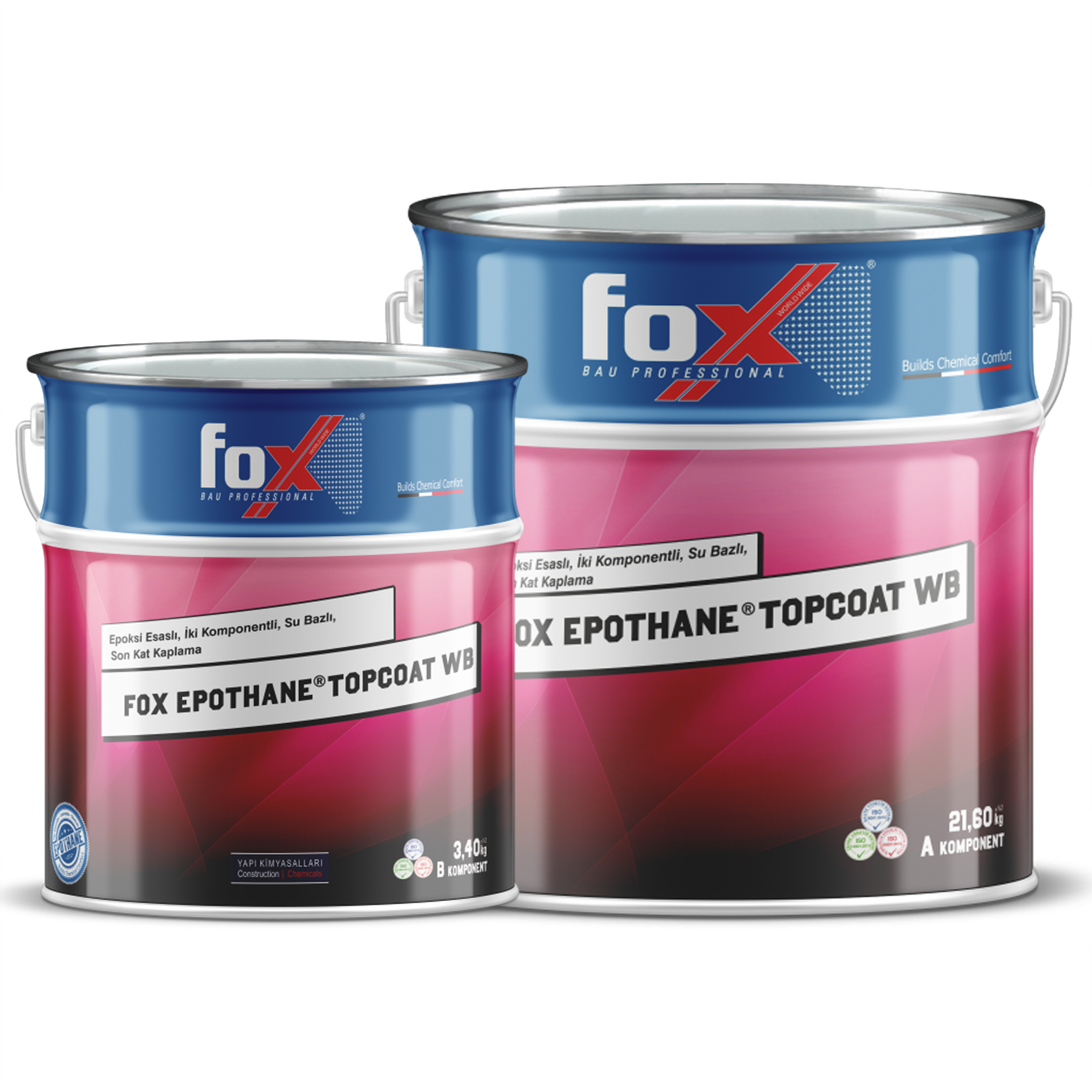
FOX EPOTHANE® TOPCOAT WB is an epoxy-based, two-component, water-based, coloured topcoat coating material with high mechanical abrasion resistance, hygienic properties and no solvents. It meets TS EN 1504-2 Principles 1.3, 2.2 and 8.2.
Colour Palette
RAL Colour Range (Matt)
Packaging
5 kg
Product Description
FOX EPOTHANE® TOPCOAT WB is an epoxy-based, two-component, water-based, coloured topcoat coating material with high mechanical abrasion resistance, hygienic properties, and no solvents. Suitable for use on concrete and cement-based mineral surfaces, the product meets TS EN 1504-2 Principles 1.3, 2.2 and 8.2. It can be thinned with water, making application easy; it is odourless and contains no substances harmful to health. It is used as a floor and wall coating in factories, production areas, warehouses, car parks, walkways, hotels, and hygienic areas such as hospitals, operating theatres, laboratories and food production facilities. Its use in drinking water tanks has been approved by the Department of Chemistry Education at Akdeniz University in accordance with the BS6290 standard. Fire class is EN 13501-1 B-s1,d0 and the Taber abrasion test (1 kg, CS10, 1000 cycles) shows approximately 55 mg weight loss.
Advantages
- Easy to apply.
- High mechanical and chemical resistance.
- Can be thinned with water.
- Odourless.
- Vapour permeable.
- Easy to clean.
- Does not harbour bacteria.
- Dust-free.
- No health hazards.
- Hygienic.
- Can be applied with an airless machine.
Usage Areas
- Concrete and cement-based mineral surfaces
- Surfaces subject to light loading such as factories, production areas, loading areas and warehouses
- Drinking water tanks (approved by the Department of Chemistry Education at Akdeniz University in accordance with the BS6290 standard)
- Car parks
- Walkways
- Hotels
- Floors and walls of hygienic areas such as hospitals, operating theatres, laboratories and food production facilities
Application Steps
- 1
Surface Preparation
The surface should be cleaned using pressurised water where possible; oil, grease, fuel and paraffin residues must be removed. The surface must be completely free of release agents, cement residues, shavings, loose particles and contaminated membranes. For sub-surface repairs, filling voids and levelling the surface, a mortar prepared by mixing 60–70 AFS (0.1–0.3 mm) quartz sand with FOX EPOTHANE® PRIMER series primer should be used.
- 2
Checking Application Conditions
Relative humidity must be a maximum of 80%. Surface, ambient and material temperatures must be between a minimum of +10°C and a maximum of +30°C. Attention must be paid to dew point and condensation; floor temperature must be kept above +10°C.
- 3
Material Acclimatisation
Materials to be used should be brought to the application site 1–2 days in advance and allowed to acclimatise to ambient conditions. In cold weather, packaging should be kept at +20°C – +25°C until ready for use.
- 4
Mixing
Before starting to mix, ensure that product temperatures are between +20°C and +25°C. Component A (containing colour, pigment and filler) should be thoroughly mixed on its own with an electric mixer until a homogeneous colour is achieved. After Component B has been fully added to Component A, mix continuously for 3–4 minutes. Mixing speed should be 300–400 rpm; avoid over-mixing to minimise air entrainment.
- 5
Priming
Surfaces to receive FOX EPOTHANE® TOPCOAT WB must have been previously primed with EPOTHANE® series primer, or on porous surfaces by adding 5–10% water to FOX EPOTHANE® TOPCOAT WB and using it as a primer. Floor temperature (min. +10°C) must always be observed.
- 6
Topcoat Application
FOX EPOTHANE® TOPCOAT WB should be applied to the surface using a roller. To minimise roller marks, successive coats should be applied wet-on-wet. Application should be carried out along the short edge, with each new pass starting immediately adjacent to the previous one. A second roller pass over the material should be made to ensure homogeneous distribution and the absence of roller marks. Application with an airless machine is also possible. Consumption per coat is approximately 100–250 gr/m².
- 7
Cleaning of Tools
After application, tools and equipment used can be cleaned with water. Once FOX EPOTHANE® TOPCOAT WB has cured, it can only be removed from the surface by mechanical means.
- 8
Curing and Opening to Traffic
After application is complete, the coating must be protected from direct water contact for at least 24 hours. Opening to pedestrian traffic at +20°C is 20 hours, to light traffic at +20°C is 3 days, and full cure at +20°C is 7 days. Times vary according to temperature differences.
Critical
After application is complete, the coating must be protected from direct water contact for at least 24 hours. If water contact occurs, softening and blistering may develop in the coating; in this case the coating must be completely removed and reapplied.
Critical
Surface temperature, ambient temperature and material temperature must be a minimum of +10°C and a maximum of +30°C.
Critical
Relative humidity must be a maximum of 80%. Attention must be paid to dew point and condensation.
Critical
Concrete surfaces to be coated with epoxy/polyurethane must be at least 3 weeks old prior to application.
Critical
Mixing must always be carried out with an electric mixer at 300–400 rpm and the specified epoxy/polyurethane resin mixing tip. Otherwise, air will be entrained into the product, causing air bubbles on the coating surface.
Important
The floor temperature must be above +10°C; otherwise dew point and water vapour condensation will damage the coating.
Important
Materials to be used should be brought to the application site 1–2 days in advance and allowed to acclimatise to ambient conditions.
Important
In cold weather, product packaging should be kept at +20°C – +25°C until ready for use.
Important
Rain, dust, wind, animals and insects must be prevented from entering the building while the coating is still fresh.
Important
The product should be stored in its original unopened packaging in a dry and cool environment (between +5°C and +30°C), protected from sunlight and frost. Shelf life is 12 months from the date of manufacture.
Important
Opened packaging must be resealed and consumed within 1 week. Pallets must not be stacked on top of one another during storage.
Important
During storage and application, contact with skin and eyes must be avoided; in case of contact, wash thoroughly with plenty of water and soap; if swallowed, seek medical attention immediately.
Important
It is dangerous to approach storage and application areas with open flames; areas must be ventilated.
Information
Consumption figures are given for 20°C; actual consumption may vary depending on surface texture and ambient temperature. It should be noted that consumption will increase on rough surfaces and in cold weather conditions.
Information
Curing times are affected by ambient temperature, floor temperature and air humidity. Curing slows at low temperatures and accelerates at high temperatures.
Related Products
Similar products to this item