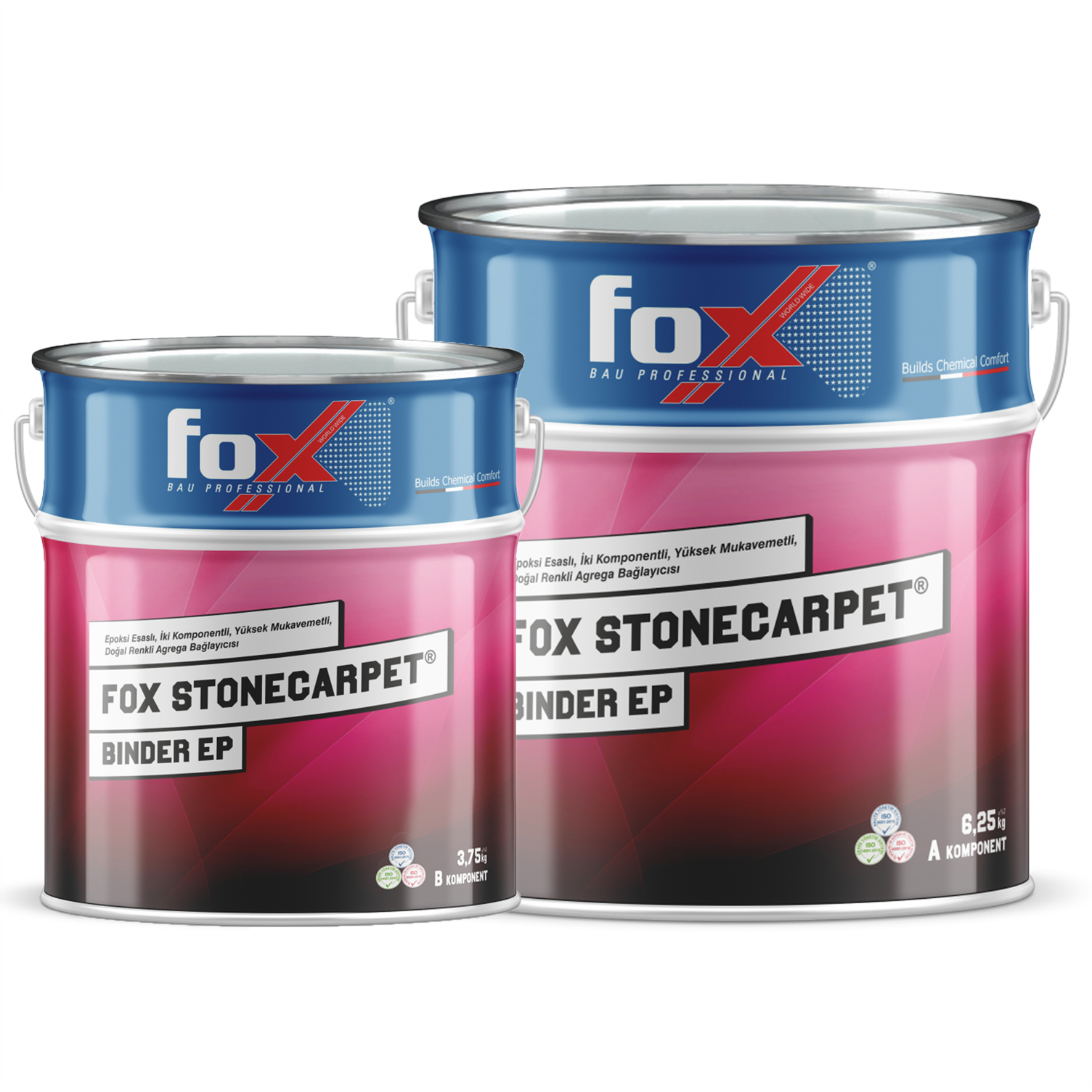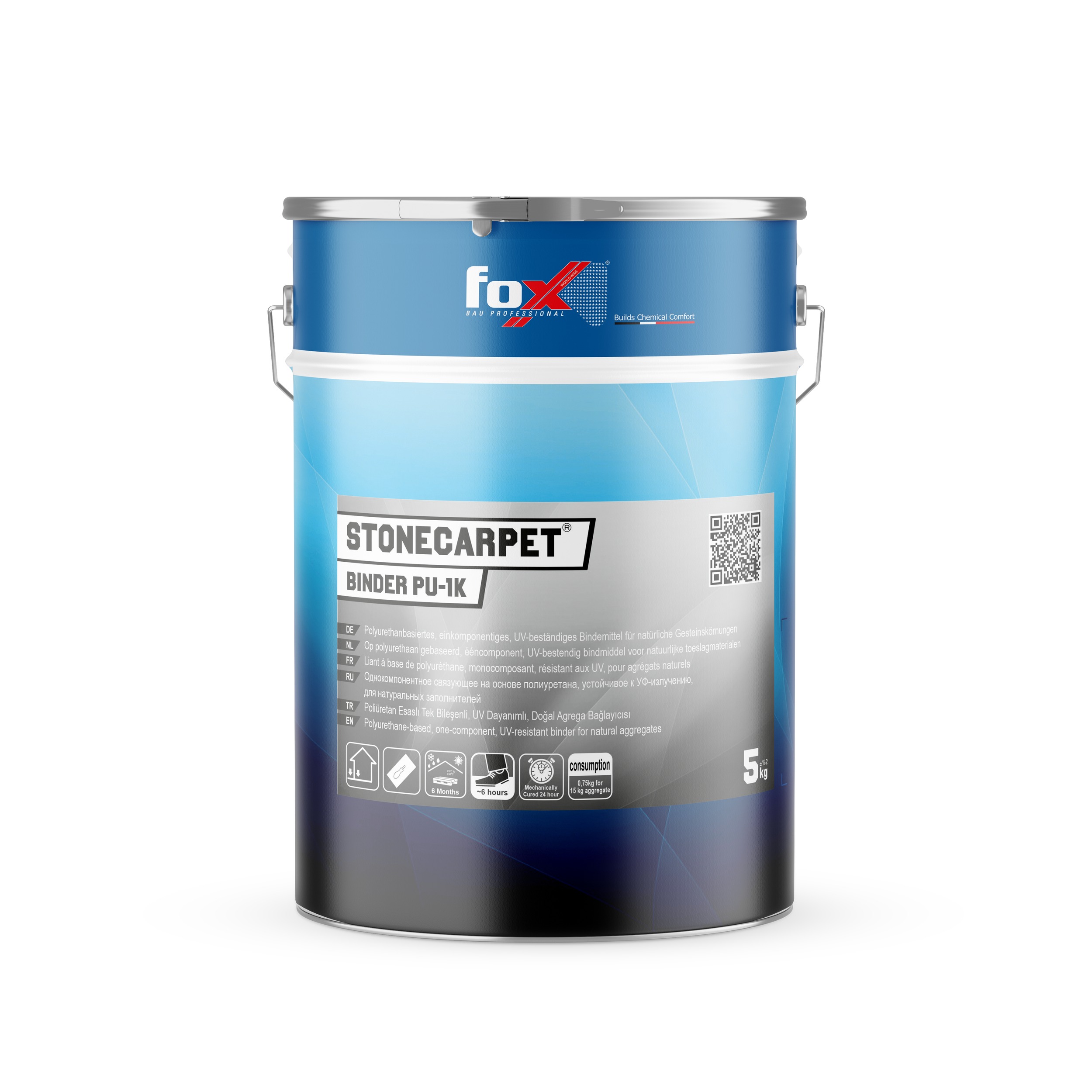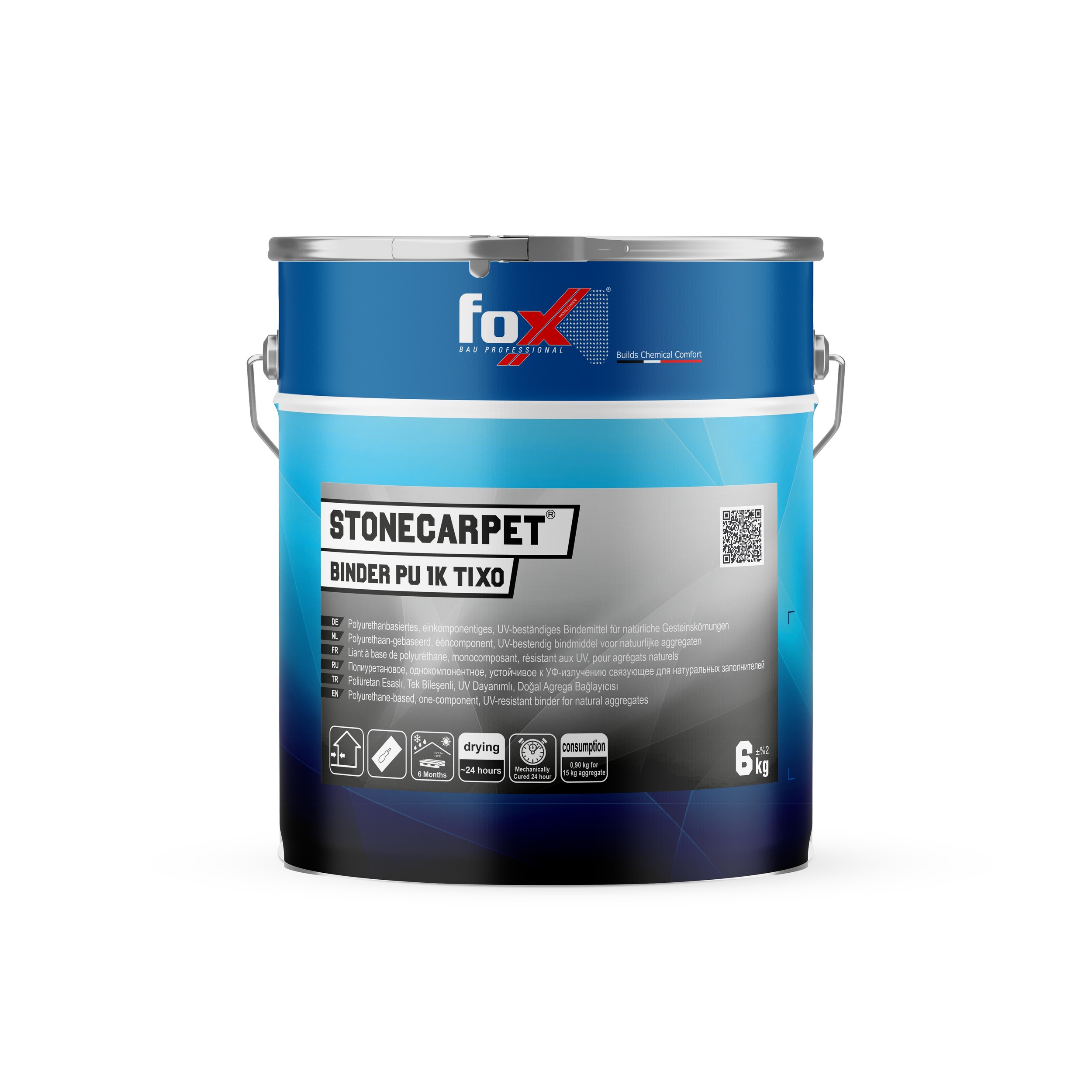


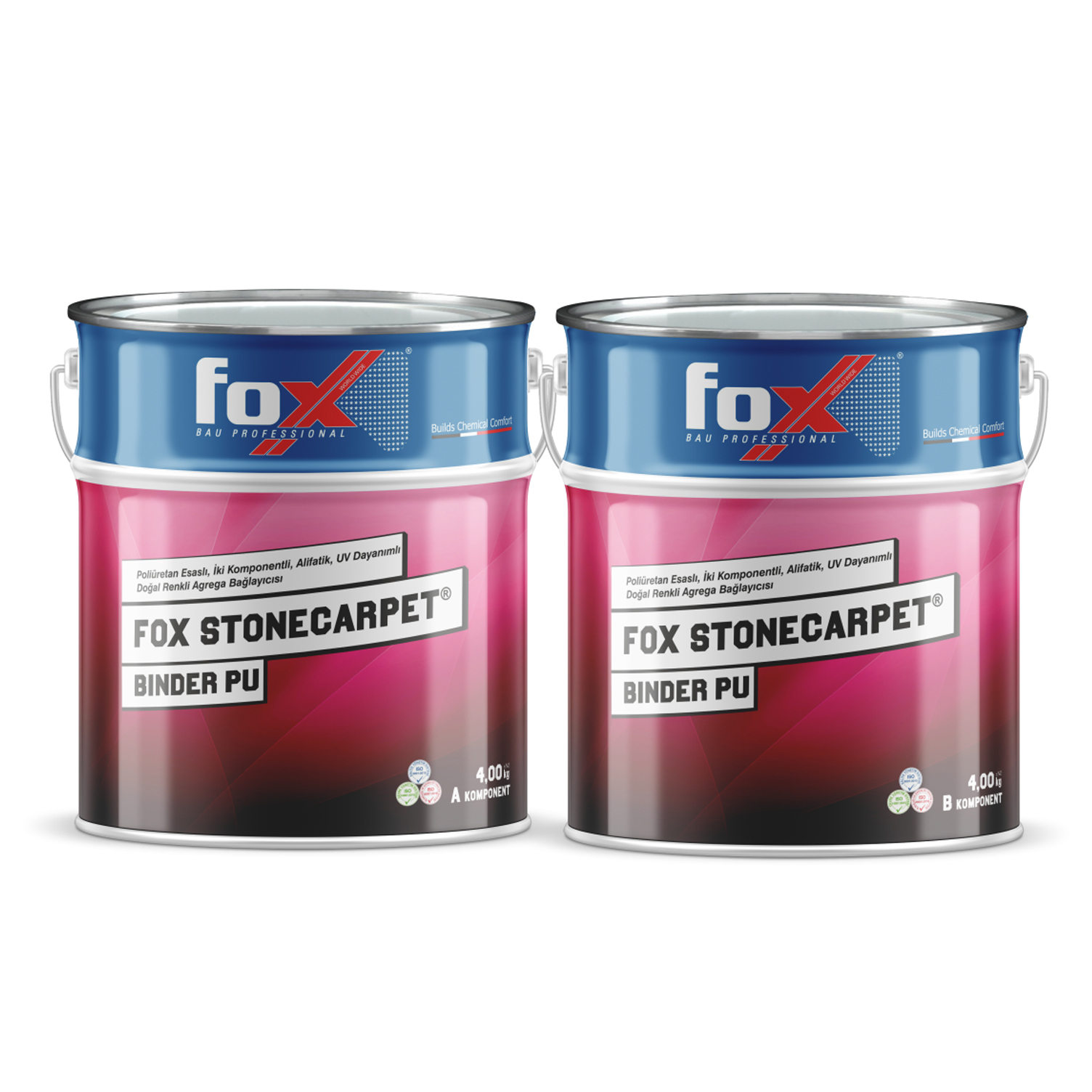
FOX STONECARPET® BINDER PU is a polyurethane-based, two-component, aliphatic binder for specially selected crushed and tumbled natural-coloured aggregates that does not yellow under UV and solar radiation. It is designed to create aesthetic and long-lasting decorative floor coverings on horizontal surfaces in interior and exterior applications.
Colour Palette
Transparent
Packaging
8 kg
Product Description
FOX STONECARPET® BINDER PU is a polyurethane-based, two-component, aliphatic, special natural aggregate binder that does not yellow under UV and solar radiation. It bonds crushed and tumbled natural-coloured aggregates together to create aesthetically pleasing, pedestrian-traffic-resistant decorative floor coverings. It serves as the binding component in FOX STONECARPET® and FOX PEBBLEDECK systems. Its transparent colour highlights the natural colours of the aggregate. The product is prepared by mixing components A and B in specified ratios; it is compatible with aggregates of 1–3 mm and 2–4 mm sizes. It can be applied at temperatures between +10°C and +30°C. With a density of 1.04±0.05 gr/cm³, the product has a working time of approximately 45 minutes and a full cure time of 7 days.
Advantages
- Suitable for use in interior and exterior applications.
- Provides an aesthetic appearance to the surface.
- Long-lasting durability.
- UV resistant.
- Different aggregate sizes can create different visual effects.
Usage Areas
- Interior and exterior areas
- Horizontal surfaces
- As a binder in FOX STONECARPET®, FOX PEBBLEDECK systems
- Airports
- Hospitals
- Galleries
- Shopping centres
- Supermarkets
- Shops and showrooms
- Hotels
Application Steps
- 1
Surface Preparation
The concrete substrate to be coated must be opened to a porous surface using abrasive equipment such as shot blasting, milling or diamond grinding to remove the cement laitance. Weak concrete fragments must be removed, small voids and holes must be fully opened, and the resulting dust must be cleaned with an industrial vacuum. Substrate repairs and filling of voids must be carried out with FOX MORTAR FC188 T repair mortar. The floor compressive strength must be at least 25 N/mm², tensile strength at least 1.5 N/mm², moisture content maximum 4%, and temperature minimum +10°C.
- 2
Priming
Surfaces to receive FOX STONECARPET® BINDER PU must be primed in advance with a suitable primer from the EPOTHANE® series. Primer selection should be made according to the surface condition: FOX EPOTHANE® PRIMER or FOX PURMAX® PRIMER 1K RAPID for standard concrete; FOX EPOTHANE® PRIMER WB for damp surfaces; FOX EPOTHANE® PRIMER SL for highly porous surfaces; FOX EPOTHANE® PRIMER HB or WA for steel and aluminium surfaces; FOX EPOTHANE® PRIMER WA for ceramic, marble and granite. Floor temperature must be a minimum of +10°C.
- 3
Mixing
Before starting to mix, ensure that the product temperatures are between +10°C and +30°C. Mix component A, FOX STONECARPET® BINDER PU, with a suitable mixer for 1 minute without entraining air. Then pour component B onto component A and mix continuously for 2 minutes until a homogeneous mixture is obtained. After components A and B have been mixed, add the selected aggregates and mix for a further 2–3 minutes. Avoid over-mixing to prevent air entrainment. Mixer speed must be 300–400 rpm.
- 4
Application by Trowel
The prepared mixture is poured onto the surface and spread to the desired thickness using a suitable trowel or screed.
- 5
Application by Power Float
The prepared mixture is poured onto the surface. To achieve a continuous and even floor, power floating with a pan is carried out when the surface has reached a consistency capable of bearing the weight of the machine or when the footprint depth is 0.5 cm.
- 6
Cleaning of Tools
After application, tools and equipment must be cleaned with solvents such as FOX CS810 or FOX C380. Once the mixture has hardened, it can only be removed by mechanical means.
Critical
The application, surface and ambient temperature must be a minimum of +10°C and a maximum of +30°C. Application must not be carried out outside this temperature range.
Critical
After the application is completed, the coating must be protected from direct water contact for at least 24 hours. Water contact causes the coating to soften and blister; in this case the coating must be completely removed and reapplied.
Critical
Concrete surfaces to be coated with epoxy/polyurethane must be at least 3 weeks old prior to application.
Critical
Mixing must be carried out using an electric mixer at 300–400 rpm with the specified epoxy/polyurethane resin mixing paddle. Otherwise, air bubbles will form on the coating.
Critical
Surface moisture content must be below 4%; there must be no rising moisture according to ASTM (polyethylene sheet test).
Critical
The floor temperature must be at least +3°C above the dew point. Condensation and water vapour accumulation will damage the coating.
Important
Opened packages must be resealed and consumed within 1 week. Pallets must never be stacked on top of each other during storage.
Important
Materials to be used should be brought to the application site 1–2 days in advance and allowed to acclimatise to ambient conditions. In cold weather, packages should be kept at +20°C – +25°C to bring them to a ready-to-use state.
Important
Rain, dust, wind, animals and insects must be prevented from entering the area while the coating is still fresh.
Important
Relative air humidity must be a maximum of 80%.
Critical
Open flames near storage and application areas are dangerous; areas must be ventilated. Protective gloves, goggles and a mask must be worn during application. Contact with skin and eyes must be avoided; in case of contact, wash thoroughly with plenty of water and soap. In case of ingestion, consult a doctor immediately.
Important
The product must be stored in its original unopened packaging in a dry, cool environment between +5°C and +30°C, protected from sunlight and frost. Shelf life is 12 months from the date of manufacture.
Information
Consumption figures are given for ideal conditions where ambient and surface temperature is assumed to be +20°C. Consumption may increase on uneven surfaces and in cold weather conditions.
Information
In resin-based systems, pot life and curing times are affected by ambient temperature, floor temperature and air humidity. Curing slows at low temperatures and accelerates at high temperatures.