

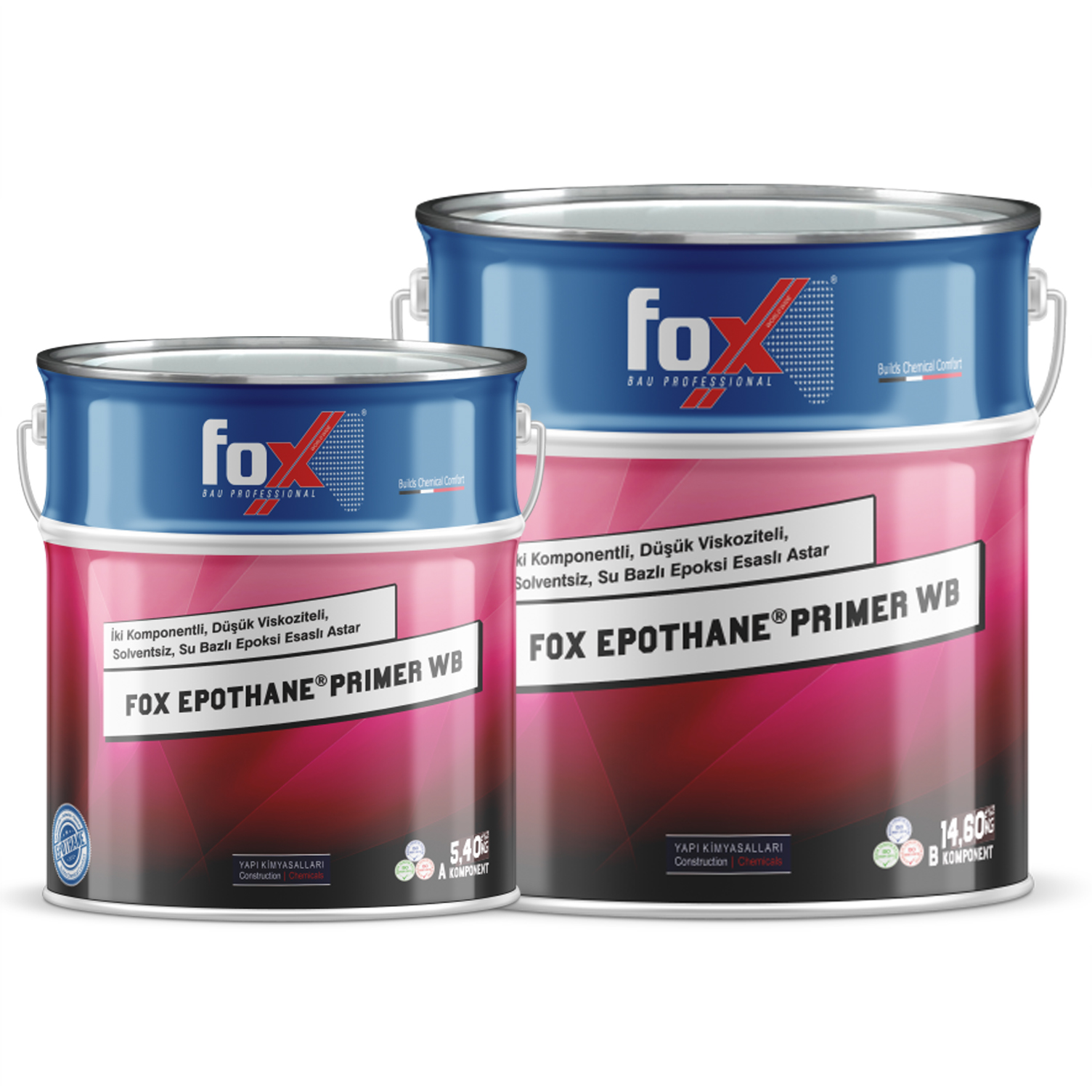
FOX EPOTHANE® PRIMER WB is a two-component, solvent-free, water-based, breathable epoxy primer set that can be applied to damp surfaces and substrates subject to negative water pressure. Its low viscosity and high adhesion properties provide a reliable base beneath epoxy and polyurethane floor coatings.
Colour Palette
Transparent
Packaging
5 kg
Product Description
FOX EPOTHANE® PRIMER WB is a two-component, solvent-free, water-based, breathable epoxy primer set that can be applied to damp surfaces and substrates subject to negative water pressure. It can be used on non-porous and absorbent concrete surfaces, in areas with rising moisture and negative-direction moisture ingress. It forms a waterproof layer in cement-based systems and acts as a bonding layer between old and new concrete. It is applied as a primer beneath FOX EPOTHANE® series epoxy floor coatings, FOX PURATHANE® series polyurethane floor coatings, and FOX PURMAX® series polyurethane waterproofing coatings. The product has a density of 1.0 gr/cm³, is transparent in colour, and has an adhesion strength to concrete of more than 3 N/mm². At +25°C, the pot life is 1 hour, drying time is 5–6 hours, and full cure time is 7 days. The product must be used without thinning.
Advantages
- Suitable for indoor and outdoor use.
- Can be applied in enclosed spaces.
- Low odour.
- Solvent-free.
- Non-flammable (water-based).
- Easy to apply.
- Low viscosity.
- Impermeable to liquids.
- High mechanical abrasion resistance.
- High surface adhesion.
- High bond strength.
Usage Areas
- As a primer on non-porous concrete surfaces
- As a primer on absorbent surfaces
- As a primer in areas with rising moisture and negative-direction moisture ingress
- As a primer in cement-based systems
- As a waterproof layer on concrete
- As a bonding layer between old and new concrete
- As a primer prior to epoxy and polyurethane coatings
- As a primer beneath FOX EPOTHANE® series epoxy floor coatings
- As a primer beneath FOX PURATHANE® series polyurethane floor coatings
- As a primer beneath FOX PURMAX® series polyurethane waterproofing coatings
Application Steps
- 1
Surface Preparation
The concrete substrate to be coated must be prepared using abrasive equipment such as shot blasting, milling, or diamond grinding to remove the cement laitance and achieve an open-pore surface. Weak concrete fragments must be removed, and small voids and holes must be fully opened. The resulting dust must be cleaned with an industrial vacuum. Voids and irregularities should be filled with a mortar obtained by mixing FOX EPOTHANE® PRIMER WB with 60–70 AFS (0.1–0.3 mm) quartz sand. The concrete compressive strength must be at least 25 N/mm², tensile strength at least 1.5 N/mm², and substrate temperature a minimum of +5°C; ensure the substrate temperature is at least +3°C above the dew point.
- 2
Checking Application Conditions
Relative air humidity must be a maximum of 80%. Surface temperature, ambient temperature, and material temperature must be within the range of minimum +5°C and maximum +30°C. Attention must be paid to dew point and condensation; the substrate temperature must be kept at least +8°C above the dew point. Materials should be brought to the application site 1–2 days in advance and allowed to acclimatise to ambient conditions.
- 3
Mixing
Verify that the product temperatures are between +5°C and +30°C. Mix component A of FOX EPOTHANE® PRIMER WB with a suitable mixer for 1 minute without entraining air. Then pour component B onto component A and mix for 2 minutes at 300–400 rpm using an electric mixer and an epoxy/polyurethane resin mixing paddle until a homogeneous mixture is obtained. Avoid over-mixing to minimise air entrainment.
- 4
Application
FOX EPOTHANE® PRIMER WB is applied in two thin coats using a roller. The direction of application for each coat must be perpendicular to the previous one. Consumption: 100–200 gr/m² for the primer coat, which may increase up to 200–500 gr/m² depending on surface roughness and the filling system.
- 5
Tool Cleaning
After application, tools and equipment used can be cleaned with solvent. Once FOX EPOTHANE® PRIMER WB has cured, it can only be removed from the surface by mechanical means.
Critical
The substrate temperature during application must be a minimum of +5°C and a maximum of +30°C. Application must not be carried out outside this range.
Critical
FOX EPOTHANE® PRIMER WB freezes at temperatures below 0°C; frozen product must not be used.
Critical
After application is complete, the coating must be protected from direct water contact for at least 24 hours. In the event of water contact, the coating will soften and blister, losing its properties; in this case the coating must be completely removed and reapplied.
Critical
Relative air humidity must be a maximum of 80%. Attention must be paid to dew point and condensation; the substrate temperature must be at least +8°C above the dew point.
Critical
Using FOX EPOTHANE® PRIMER WB as a primer in areas with rising moisture or negative-direction water ingress does not mean it will act as a moisture barrier. The coating to be applied over the primer must be a breathable coating.
Important
Concrete surfaces to be coated with epoxy/polyurethane must be at least 3 weeks old prior to application, a vapour barrier layer must be formed in slabs on grade, and the building's roof, walls, doors, and windows must be completed.
Important
Mixing must be carried out exclusively with an electric mixer at 300–400 rpm and an epoxy/polyurethane resin mixing paddle. Failure to use the specified mixing paddle will entrain air into the product, resulting in air bubbles on the coating surface after application.
Important
Before starting to mix, ensure that the product temperatures are between +5°C and +30°C. Mix component A for 1 minute without entraining air, then add component B and mix for 2 minutes until a homogeneous mixture is obtained. Avoid over-mixing.
Important
Materials to be used should be brought to the application site 1–2 days in advance and allowed to acclimatise to ambient conditions.
Important
In cold weather, the ambient and substrate temperatures should be raised, and products should be conditioned at +20°C–+25°C before use.
Important
Rain, dust, wind, animals, and insects must be prevented from coming into contact with the coating while it is still fresh.
Important
Opened containers must be tightly resealed, stored under appropriate conditions, and used within one week.
Information
When stored at room temperature, away from direct sunlight, between +5°C and +30°C, the shelf life is 12 months from the date of manufacture.
Important
It is dangerous to approach storage and application areas with open flames; areas must be ventilated. Work clothing, protective gloves, goggles, and a mask must be worn during application.
Important
Avoid contact with skin and eyes; in case of contact, wash thoroughly with plenty of water and soap. If swallowed, seek medical attention immediately. Store out of reach of children.
Information
Consumption figures are given for ideal conditions assuming an ambient and surface temperature of 20°C. It should be noted that consumption will increase on uneven surfaces and in cold weather conditions.
Information
In resin-based systems, pot life and cure times are affected by ambient temperature, substrate temperature, and air humidity. Curing slows at low temperatures and accelerates at high temperatures.
Related Products
Similar products to this item